

Mini Watercolor Art for Small Spaces: A Practical Guide
Quick Summary
Mini watercolor art is a practical way to add color to a small room without taking up floor or wall space. Small pieces fit narrow walls, doorways and desks, and several of them grouped together look balanced rather than crowded.
- Small watercolors fit narrow walls, shelves, and gaps between furniture.
- Start with simple subjects like leaves, single flowers, or basic landscapes.
- Use a limited palette of three to five colors for cohesive mini paintings.
- Tape paper flat, wet it lightly, and let each wash dry before adding detail.
- Keep frame and mat sizes identical across a series so the group reads as one unit.
Table of Contents
- Why Mini Watercolor Art Works in Small Rooms
- Tiny Watercolor Painting Ideas for Beginners
- Step-by-Step: Painting a Mini Watercolor Piece
- Choosing Mini Watercolor Prints and Size for Your Wall
- How to Display Small Art in Compact Rooms
- Start Your Own Small Collection With Panoply Fine Art
- Frequently Asked Questions
Why Mini Watercolor Art Works in Small Rooms
Mini watercolor art for small spaces is one of the easiest ways to add color to a tight apartment without losing floor or wall room. Small pieces fit on narrow walls, beside doorways, and over desks where a large canvas would overwhelm. Panoply Fine Art, a Sacramento gallery, has built a collection around this idea. Here is why it works.
Small rooms feel crowded fast. Step-by-step guidance on displaying fine art in tight apartments walks through layout and placement for compact spaces. A single large piece can dominate a wall, but several small works spread across a space feel balanced.
Small watercolors can be less costly to frame than large pieces. A piece that measures a few inches across is easier to move when you rearrange your room. It is also easier to change your display with the seasons.
- Fits narrow walls, shelves, and gaps between furniture
- Works in groups that look planned, not crowded
- Easy to swap out as your taste changes
Tiny Watercolor Painting Ideas for Beginners
Tiny watercolor painting ideas are a good starting point if you have never painted before. Small sizes keep projects short, so you can finish a piece in one sitting. That quick win helps build confidence.
Start with simple subjects. Shapes, leaves, single flowers, and basic landscapes are all easy to paint at a small scale. Keep your brush strokes loose and avoid fine detail until you get comfortable with how water moves on paper.
Miniature Landscapes and Small Floral Subjects
Miniature landscapes work well because they need only a few layers. Try a horizon line, a soft sky wash, and one or two shapes for hills or trees. Small floral subjects are equally forgiving. A cluster of three or four blooms in a simple vase can carry an entire piece.
Use a limited palette. Three to five colors are enough for most mini paintings. Limited color keeps small works calm and cohesive, which suits compact rooms.
Painting Without Drawing First
Many beginners feel stuck at the pencil stage. You can skip sketching altogether. Load your brush with pigment, lay down one wash, and let the shape come from the color. Wet-on-wet techniques let edges blur into something recognizable without precise lines.
If you want guidance, sketch lightly with a pencil only where you need a fixed position. Otherwise, let the paint lead.
Step-by-Step: Painting a Mini Watercolor Piece
This process works for most small-format paper. Plan for about 30 to 45 minutes once you are set up.
What you will need:
- Mini Watercolors set (brush included)
- Small watercolor paper, about 3 x 3 inches or 4 x 3 inches
- A cup of clean water and a paper towel
- A pencil and a cardboard template to mark your border, if you want one
Steps:
- Tape your paper to a flat surface so it does not warp.
- Wet the paper lightly with clean water and a soft brush.
- Drop in your first color at the top edge and let it spread.
- Add a second color while the surface is still damp, letting the two blend.
- Let the wash dry completely before adding any detail.
- Add one or two small accents, such as a dark line for a tree trunk or a dot for a flower center.
- Wait until the piece is fully dry, then remove the tape.
Watch out: over-brushing a small area can lift pigment and leave muddy patches. Make one confident pass, then stop.
The process below breaks the painting into steps, each with a rough time or timing cue.
| Step | What to do | Time or timing |
|---|---|---|
| 1 | Tape paper to a flat surface | Before wetting |
| 2 | Wet paper lightly with clean water | Before first color |
| 3 | Drop in first color at top edge | While paper is damp |
| 4 | Add second color and let it blend | While surface is still damp |
| 5 | Let the wash dry completely | Until fully dry |
| 6 | Add one or two small accents | After wash is dry |
| 7 | Remove tape once fully dry | After final accents |
| Overall | Complete the piece in one sitting | About 30 to 45 minutes |
Choosing Mini Watercolor Prints and Size for Your Wall
Sizing a mini watercolor for a small room is a measurement problem before it is a taste problem. Work in this order: measure the wall, subtract the furniture and fixtures that eat into it, then choose art that fills the remaining space without crowding it.
Measure the usable wall. Run a tape measure along the full width and height of the wall, then note anything that interrupts it: a door swing, a light switch, a radiator, the back of a chair. The clear rectangle that remains is your canvas.
Match art size to furniture. A piece hung over a sofa, console, or desk should span about two-thirds of the furniture's width. Over a 48-inch console, that points to a grouping about 30 to 34 inches wide.
Plan the layout on paper first. Cut paper rectangles to the exact outside dimensions of each framed piece, including the frame and mat, and tape them to the wall with painter's tape. This lets you judge spacing and height before you put a nail in.
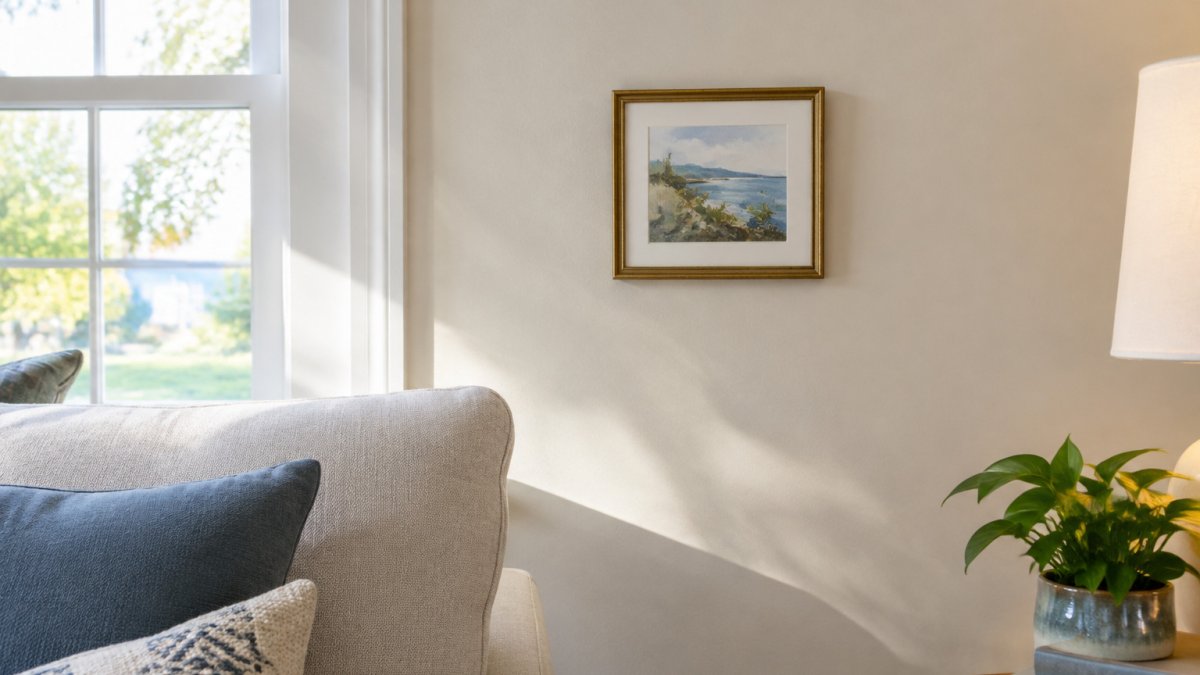
Choose a frame size that supports the art. A 4 x 6 inch painting in a 1-inch frame reads as 6 x 8 inches on the wall; add a 2-inch mat and it reads as 10 x 12 inches. Wider mats make small watercolors feel more substantial and protect the paper from touching the glazing. For a series, keep frame and mat sizes identical so the eye reads the group as one unit. Consistent framing gives a series cohesion, while the same attention to scale helps you choose art for small walls without letting the display overwhelm the space.
Watch out: hanging a single tiny piece centered on a large blank wall makes the room feel emptier, not cozier; group two or three pieces or choose a larger frame with a generous mat instead.
How to Display Small Art in Compact Rooms
Display is where small watercolors either look intentional or get lost. Treat framing, protection, hanging, and lighting as one system rather than four separate chores.
Frame and mount for protection. Watercolor paper is absorbent and sensitive to light and moisture.
Keep moisture away. Avoid hanging watercolors in bathrooms, directly above a kitchen stove, or against an exterior wall that condenses in winter.
Hang at the right height. Place the center of the piece or grouping at roughly 57 to 60 inches from the floor, the typical eye level for an adult.
Use renter-friendly hardware. Adhesive picture hangers rated for the weight of the framed piece avoid nail holes and work well for pieces under about 10 pounds. For heavier or valuable work, use a nail or screw into a stud, or a drywall anchor rated above the frame's weight. A picture rail or a narrow floating shelf lets you lean and rotate small pieces without rehanging.
Light it without fading it. A small LED picture light or a nearby lamp with a warm bulb shows watercolor texture better than harsh overhead light.
Rotate and group. Change pieces seasonally by storing the rest flat in an acid-free portfolio. Group by palette or subject so a cluster of minis reads as a collection rather than a scatter of unrelated frames.
Watch out: hanging a watercolor in a steamy bathroom or in direct afternoon sun is the fastest way to wrinkle the paper or fade the color, no matter how good the frame is.
Start Your Own Small Collection With Panoply Fine Art
A small collection grows over time. Start with one or two pieces you love, then add to them as your space and taste develop. Panoply Fine Art features the work of more than 20 artists, including Sacramento artist Tom Matousek, and offers fine art, prints, and branded merchandise. You can browse the collection online at Panoply Fine Art, or visit the gallery in Old Sacramento to see pieces in person. Shop Mini Watercolors today and bring a little color to your smallest room.
Frequently Asked Questions
What are some ideas for tiny watercolor paintings?
Simple subjects work best at small sizes. Try a single flower bloom, a loose tree silhouette, a pair of hills with a sky wash, or a small bowl of fruit. Keep shapes bold and details minimal, since a 3x3 inch or 4x3 inch format leaves little room for fussy work. Use a limited palette of two or three colors so the piece reads clearly from across a room. Repeating a theme across several small pieces, such as a set of tiny landscapes, also creates a cohesive look on a wall.
Are small watercolor paintings easy for beginners?
Yes, in many cases they are easier than large pieces. A small format limits how much you need to plan and how many brushstrokes you must control, and a painting can often be finished in minutes. Beginners can start with one simple shape, a light wash, and one or two accent marks. Keeping a consistent paper size and using a cardboard template to mark borders helps a set of small paintings look unified.
How can you display mini watercolor paintings without cluttering a wall?
Group small pieces in a tight grid with equal spacing, typically two to three inches between frames, so they read as one arrangement. Choose matching or complementary frames in a single finish. Hang the group at eye level in a single zone rather than spreading pieces across the room. A single large mat with several small openings can also hold multiple paintings together.
What is the best mini watercolor set for beginners?
Panoply Fine Art offers Mini Watercolors at $4.50, which include a brush and vibrant, nontoxic colors suitable for ages 4 and up. They are a low-cost way to test small-format painting before buying larger supplies. Pair them with a small pad of watercolor paper and a jar of clean water to start practicing the techniques described above.
